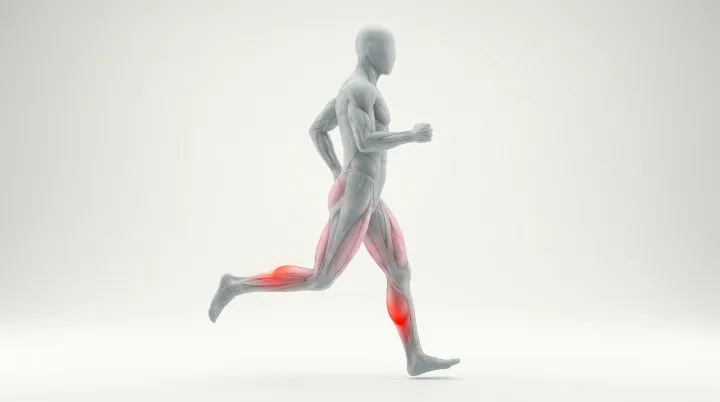
The Trail Run is a expert-friendly bodyweight strength exercise that targets the quadriceps, glutes and calves, with the hamstrings and abdominals working alongside. Here's how to do it right, and what to stop doing.
Primary musclesQuads, Glutes, Calves
Secondary musclesHamstrings, Abs
EquipmentBodyweight
LevelExpert
TypeStrength
3D demo in the EGON app
01 Execution
How to do the Trail Run
Scan the ground a few steps ahead rather than looking directly down at your feet.
Shorten your stride and lift cadence as the gradient steepens so each step stays controlled.
Lean forward from the ankles on the climbs and drive the hips through on each push-off.
Use the arms wider than usual for balance across roots, rocks and uneven footing.
On descents, keep the feet quick and light and let the knees absorb the landing under you.
Ease back onto an even rhythm whenever the terrain flattens out, then repeat as the trail changes.
02 The payoff
Why it earns its spot
Alternates concentric climbing work with eccentric braking, which flat running never does.
Loads ankle and hip stabilizers continuously because the terrain never repeats.
Raises cardiovascular cost on climbs while lowering oxygen demand on descents, varying the stimulus.
03 Don't do this
Common mistakes
Overstriding on descents, which increases braking force and loads the knee extensors eccentrically.
Running downhill sections at race effort in training, which produces muscle damage that lasts for days.
Holding flat-ground stride length uphill, which raises effort without producing more forward speed.
Watching your feet instead of the trail ahead, which leaves no time to choose a line on uneven ground.
EGON Put it on record
Track it in EGON.
Log every set of the Trail Run, get your PRs detected automatically, earn aura for the work, and climb five leagues of statues, from Stone to Ego.